


How Can Anything Beat n log n?
Section: Home / Post
Categories: Computer Science,
Tags: Algorithms, Entropy, Information Theory,
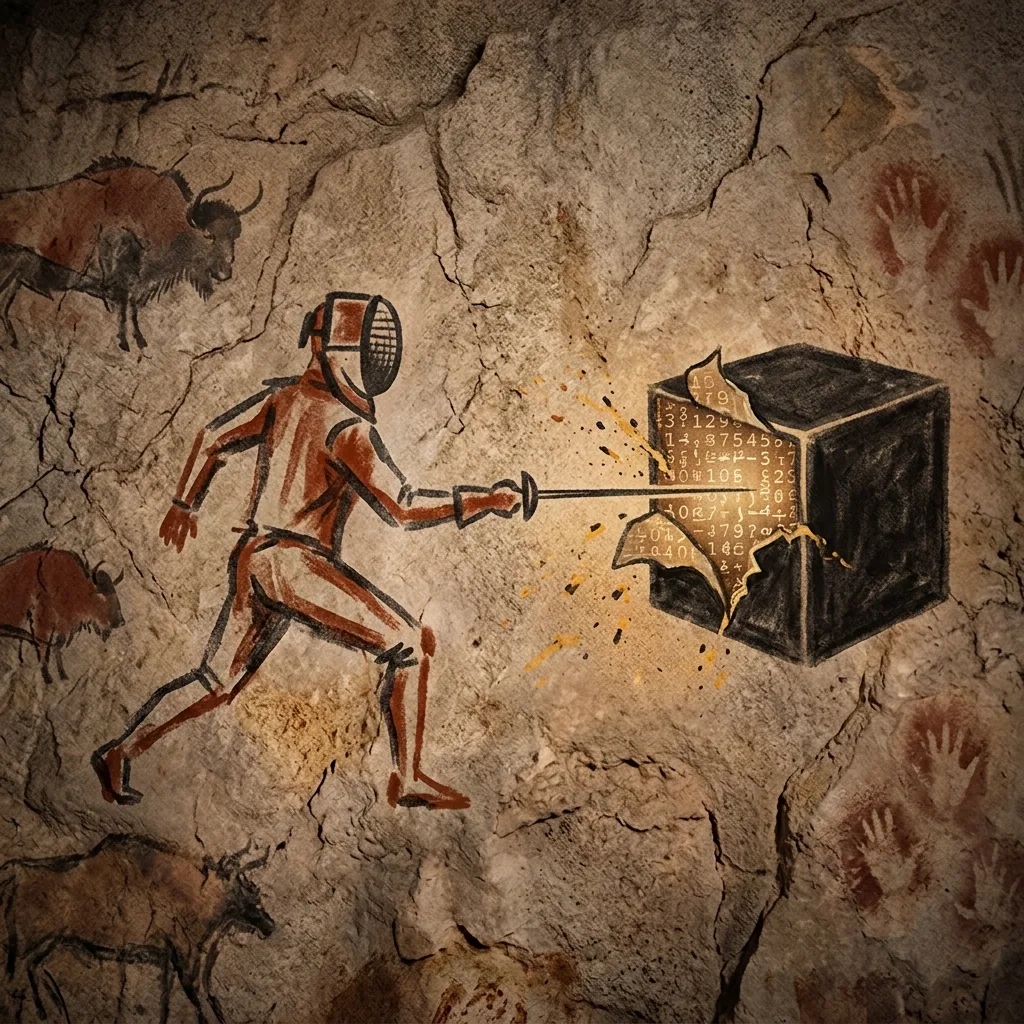
Piercing the black box to break through the $n \log n$ barrier.
Recently, headlines have kept making the rounds about sub-$n \log n$ algorithms—first Duan et al. breaking Dijkstra’s $O(m + n \log n)$ sorting barrier for directed shortest paths, and then a preprint claiming sub-$n \log n$ integer multiplication.
My first reaction was skepticism. If a problem cares about ordering $n$ items, don’t you need $\log n$ steps to uniquely place each item, repeated $n$ times? That gives $n \log n$. How could you possibly do better?
The short answer is that $n \log n$ is not a universal speed limit. It is the lower bound of a specific model of computation. To see how algorithms beat it, we need to look at what $n \log n$ actually measures—and which assumptions those algorithms drop.
What $n \log n$ Actually Looks Like
Think of sorting $n$ items as routing each item down a decision tree into its final slot.
If you are only allowed to take 2-way comparison steps (< or >), every fork in the tree has 2 branches. Each step cuts the remaining slots in half. To route one item to its unique leaf among $n$ slots, it has to travel down roughly $\log_2 n$ levels.
Send all $n$ items down a tree of depth $\log_2 n$, and you pay $n \log_2 n$ total steps.
The Hidden Assumptions
That intuition feels airtight: if characterizing or placing a single item among $n$ slots takes $\log_2 n$ steps, and there are $n$ items to process, then any task requiring ordering or classification across $n$ items seems forced to pay $n \log_2 n$. Under two specific conditions, that reasoning is airtight:
- Black-box items: You cannot peek inside an item. Your only tool is a 2-way yes/no step (like
is a < b?) that yields at most 1 bit of information per step. - Factorial-scale outcomes: The number of possible final answers grows like $n!$ (or $n^n$)—meaning each of the $n$ items could end up in one of roughly $n$ distinct roles or positions. Not every task on $n$ items has that many outcomes: finding the maximum has only $n$ possible answers and assigning yes/no labels has $2^n$, compared to $n!$ orderings for sorting.
How Existing Algorithms Break $n \log n$
Counterexamples already exist in every algorithms textbook. Two classic ones—Bucket Sort and Radix Sort—sort $n$ numbers in $O(n)$ time when the numbers come from a bounded range or fixed digit width:
- Bucket Sort computes a bucket address directly from each number’s value, drops the item straight into that bucket in a single step (when numbers map cleanly into $n$ slots, that is a direct $n$-way lookup), and then reads the buckets back in order.
- Radix Sort processes numbers one digit at a time. In Most-Significant-Digit (MSD) Radix Sort, 3-digit numbers are first routed into 10 buckets (
0–9) by their hundreds digit; only buckets holding more than one item are split again by their tens digit, and so on—without ever comparing two numbers against each other.
Neither algorithm breaks mathematics. Both drop the black-box assumption—and flatten the tree.
Imagine lining up 30 kids by birth month. If you treat them as black boxes and only compare pairs of kids (“who was born earlier?”), you are stuck with a 2-way tree of depth $\log_2 n$. Instead, put 12 labeled boxes on the floor (Jan through Dec). Each kid looks at their own birth month and walks straight to their box in one step.
Computers can do the same thing because numbers aren’t opaque black boxes—they are digits and bit patterns, and hardware can jump directly to a memory address in a single step. Direct indexing widens the branching factor all the way to $n$, collapsing the tree to depth 1. MSD Radix Sort makes the intermediate case just as clear: it routes the exact same items down a tree, except each node has 10 branches (0–9) instead of 2, flattening the depth from $\log_2 n$ down to the number of digits—with zero comparisons. (As we will see next, when numbers are allowed to grow arbitrarily large with $n$, escaping $n \log n$ asymptotically requires choosing the branching factor as a function of $n$ rather than keeping it fixed at 10.)
The Information-Theoretic View
Why does widening the branching factor break $n \log n$, and when is a lower bound truly unavoidable? Information theory puts both assumptions into a single equation.
In an earlier post on entropy, I framed entropy $H$ as the minimum number of binary choices (bits) needed to describe categories of events:
$$ H(\text{outcomes}) = -\sum_i p_i \log_2 p_i $$
That same lens gives us a hard floor for any algorithm.
Let $N$ be the total number of possible final answers to a problem—a function of the input size $n$, not $n$ itself. When every answer is equally likely (the worst case, $p_i = 1/N$), the entropy of the answer space simplifies to:
$$ H(N) = -\sum_{i=1}^{N} \frac{1}{N} \log_2 \frac{1}{N} = \log_2 N $$
Why is $H(N) = \log_2 N$ a hard floor for 2-way steps? Let $q$ be the number of 2-way (yes/no) steps an algorithm takes. Those $q$ steps can produce at most $2^q$ distinct transcripts of answers. If $2^q < N$, at least two different final answers must share the exact same transcript, and no algorithm can tell them apart. Therefore:
$$ 2^q \ge N \implies q \ge \log_2 N = H(N) $$
Where does the $\log_2 n$ in $n \log_2 n$ come from? Logarithms turn multiplication into addition:
- When each item has 2 outcomes ($N = 2^n$), taking the log yields $H(2^n) = \log_2(2^n) = n$—linear, with no $\log n$.
- When all $n$ items can be ordered in $N = n!$ ways, you are multiplying $n$ factors that grow with $n$. Taking $H(n!) = \log_2(n!)$ adds up $\log_2 1 + \log_2 2 + \dots + \log_2 n$, which lands at roughly $n \log_2 n$.
Now look at what happens when you widen each step’s branching factor to $k$. Remember from the entropy post that the base of the logarithm corresponds to how many outcomes a single step can distinguish, so $q$ $k$-way steps yield $k^q$ transcripts:
$$ k^q \ge N \implies q \ge \frac{H(N)}{\log_2 k} = \log_k N $$
Notice a crucial distinction here. Any constant $k$-way step only differs from a 2-way step by a constant factor ($1/\log_2 k$): a fixed 10-way decimal lookup trims the work by $\log_2 10 \approx 3.32\times$, and a fixed 256-way byte lookup trims it by $8\times$, yet as $n$ grows without bound (and distinct numbers need at least $\log_k n$ digits), both stay locked to $O(n \log n)$ forever.
To actually escape $n \log n$, $k$ must be a function of $n$ (for example, $k = \sqrt{n}$ or $k = n$). Once $k$ scales with $n$ as $k = n^\alpha$, $\log_2 k = \alpha \log_2 n$ cancels the $\log_2 n$ in $n \log_2 n$, so the total number of steps is only off from a one-shot $n$-way lookup by a constant factor ($1/\alpha$)—that is, linear $O(n)$. Radix Sort achieves this when its base $k$ is chosen relative to the size and range of the numbers (e.g., $k = n$ or $k = \sqrt{n}$): we are using the numerical value of the input itself to inform the algorithm’s addressing, piercing the black box.
Entropy Is a Floor, Not a Guarantee
One important nuance: having $H(N) = \log_2 N$ bits of entropy does not guarantee you can solve a problem in $\log_2 N$ steps (or $\log_k N$ steps with a $k$-way step).
Compare searching a sorted list against finding the maximum of an unsorted list. Both have $N = n$ possible answers, so both have the exact same entropy: $H(n) = \log_2 n$ bits. Yet finding the max takes $n - 1$ comparisons, because each step only knocks out one loser—it cannot cut the remaining candidates in half.
More generally, to reach $q \approx \log_k N = H(N) / \log_2 k$ steps with a $k$-way step over $N$ possible outcomes, each step must partition the remaining candidates symmetrically (evenly) into $k$ disjoint buckets of roughly $N/k$ outcomes. That is what lets every step shrink the answer space by division ($N \to N/k$) and extract the full $\log_2 k$ bits toward the answer.
When a step is asymmetric—say, checking “is item $i$ the target?” on an unsorted list, where one branch isolates $1$ outcome and the other leaves $N - 1$—the worst-case branch shrinks by subtraction ($N \to N - 1$) instead of division, so you never reach $\log_k N$. Finding the maximum runs into a related failure: a > b has two equally likely outcomes, yet on the answer space of $N$ candidate maxima it only discards a single loser, leaving $N - 1$ candidates alive either way because the remaining information is spent on relative order we do not need. You only hit the entropy floor when the problem’s structure lets each step carve the remaining answers into roughly equal, disjoint fractions.
Bringing It All Together
Every complexity claim sits on two axes: how fast the answer space $N$ grows, and how much information a single $k$-way step can extract.
| Problem | Answer space ($N$) | Entropy floor ($H(N) = \log_2 N$) | Black-box 2-way steps | Breaking the black box |
|---|---|---|---|---|
| Look up a known index $i$ | $1$ | $0$ | $0$ (1 direct read) | $O(1)$ |
| Search a sorted list | $n$ | $\log_2 n$ | $\log_2 n$ | $O(1)$ (with hash/direct index) |
| Find max (unsorted) | $n$ | $\log_2 n$ | $n - 1$ | $O(n)$ (still must inspect all) |
| Label each item yes/no | $2^n$ | $n$ | $n$ | $O(n)$ |
| Sort $n$ items | $n!$ | $\sim n \log_2 n$ | $\sim n \log_2 n$ | $O(n)$ (Radix / Bucket sort) |
| Recover an $n \times n$ binary grid | $2^{n^2}$ | $n^2$ | $n^2$ | $O(n^2)$ |
So whenever you see a headline announcing a sub-$n \log n$ algorithm, there are only two ways it happened: either the problem never actually had a factorial-scale answer space in the first place (computing shortest-path distances doesn’t require sorting every vertex, and multiplying two $n$-bit integers only has $2^{2n}$ possible outputs—an entropy floor of $2n$, never $n!$), or the algorithm found a way to look inside the box and widen the branching factor $k$ with $n$.